
Android Outsmarts iPhone in Blocking Scams Here’s What the New Study Reveals
A new global study finds Android users face fewer scam texts and calls than iPhone users, thanks to Google’s powerful AI-based protection tools.
 Israr Ahmed
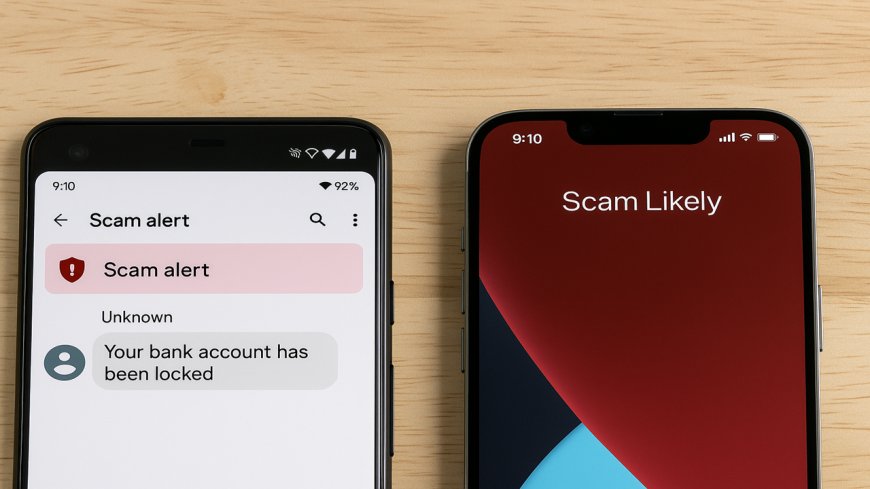
The long-standing Android vs. iPhone debate just took a dramatic turn and this time, Android comes out on top in digital safety.
A recent study by Google Security has revealed that Android users face significantly fewer scam messages and calls compared to iPhone users.
The survey, which included over 5,000 participants from the US, India, and Brazil, found that Android users were 58% more likely to receive zero scam texts, while iPhone users were 65% more likely to face multiple scam messages in a single week.
The reason? Android’s smarter, AI-driven protection tools are evolving faster than Apple’s security filters.
How Android’s AI Is Redefining Scam Protection
Android’s rise in scam prevention is not by chance it’s the result of Google’s powerful AI technology working quietly behind the scenes.
Here’s what gives Android its edge:
-
Google Play Protect: Automatically scans and removes harmful apps before they can cause damage.
-
AI Message & Call Filtering: Detects suspicious messages, fake links, and scam calls in real time.
-
Pixel Call Screening: Blocks scam calls using on-device voice recognition and machine learning.
-
Safe Browsing Alerts: Warns users before opening dangerous websites or downloading harmful content.
These multi-layered protections make Android more proactive, identifying threats before users even notice them.
Why Apple’s iPhone Is Falling Behind
Apple’s iPhone is known for its privacy and encryption strength, but when it comes to scam protection, the story is different.
The study shows that iPhone’s system struggles to detect evolving scam techniques, mainly because it relies on manual filtering and limited third-party integration.
Experts say Apple’s closed ecosystem, though great for privacy, slows down innovation in scam detection.
Unlike Android, which allows AI-based tools to learn from billions of data points globally, iPhone’s security updates come only through major iOS releases, making it less adaptive.
Still, Apple continues to lead in personal data privacy the issue is simply that its scam filters aren’t learning fast enough.
Scam Safety Starts with You Stay Smart, Stay Secure
Even with Android’s AI advantage, user awareness remains the strongest line of defense.
Cybersecurity experts recommend taking a few simple but effective steps:
-
Never click suspicious links from unknown senders.
-
Keep your device updated to get the latest security patches.
-
Enable two-factor authentication (2FA) for critical apps.
-
Download only from official app stores like Google Play or Apple App Store.
-
Use built-in scam protection tools don’t ignore warnings or alerts.
Remember, even the most advanced phone can’t protect you from human error — awareness is your best antivirus.
Pakistan’s Growing Scam Problem Why This Matters Locally
In Pakistan, digital scams are becoming increasingly sophisticated from fake prize messages to banking fraud calls.
For Pakistani users, Android’s AI-backed protection provides real-time defense against region-specific scams by identifying patterns in Urdu, Roman Urdu, and English messages.
Meanwhile, iPhone users can improve safety by enabling Silence Unknown Callers and Filter Unknown Senders under settings.
Simple settings can dramatically reduce exposure to potential threats.
Android Leads the Future of Digital Security
The new study makes one thing clear Android’s AI-powered ecosystem is redefining mobile protection.
Its ability to learn, adapt, and block scams in real time has placed it ahead of iPhone in a category where vigilance matters most.
While Apple continues to champion privacy, Android now stands as the smarter guardian against digital deception.
In a world where scam attempts grow by the day, the choice between Android and iPhone may come down to one question who protects you better?
For more trusted tech insights ,visit Nation bytes