Routine Disruptions
The habitual paralysis of Islamabad and Lahore through road blocks and snap holidays is dismantling the backbone of Pakistan’s private enterprise.
 Abdul Raheem Qaisar
“A state which is not able to change is without the means of its conservation.” — Edmund Burke.
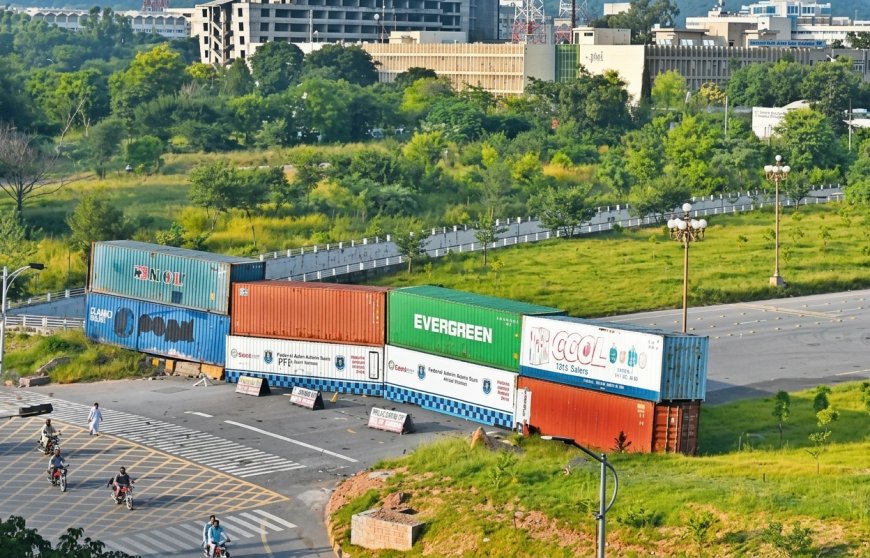
In 1948, the Soviet Union initiated the Berlin Blockade, cutting off all land and water routes to the Allied-controlled areas of the city. While the world remembers the heroic airlift that followed, history often overlooks the immediate economic asphyxiation of the local German population, whose businesses and livelihoods were held hostage by political maneuvering. Today, a similar, albeit self-inflicted, strangulation occurs in the heart of Pakistan. As Islamabad and Lahore descend into a routine of shipping containers and snap "local holidays," the private sector finds itself trapped in a recurring blockade that treats economic output as an optional luxury.
The current scenario in Pakistan's major urban centers has reached a breaking point. What was once an occasional inconvenience for a high-profile diplomatic visit has mutated into a governance strategy. Whether it is a political protest or the arrival of a foreign dignitary, the reflex of the state is to "seal" the city. For the government employee or the student, these disruptions are often welcomed as a reprieve, a paid holiday courtesy of the taxpayer. However, for the entrepreneur, the factory owner, and the daily-wage laborer, these routine disruptions represent a direct assault on their survival. The private sector, which serves as the actual engine of the national economy, cannot simply "pause" its operations every other week without facing catastrophic losses.
The disparity in impact is staggering. While the public sector remains insulated by the state's coffers, the private businessman is left to navigate broken supply chains and missed deadlines. When the roads to Islamabad’s Blue Area or Lahore’s Gulberg are barricaded, it is not just traffic that stops; it is the flow of capital. Contracts are lost, international clients grow wary of "unreliability," and the cost of doing business skyrockets. The government seems unconcerned that its reliance on Road Blocks as a security tool is effectively de-industrializing the country’s most productive hubs.
This habitual paralysis is becoming a hallmark of Public Sector Apathy. The state appears to have entered a comfort zone where it assumes the private sector will simply absorb the shock of lost man-hours. There is a profound lack of empathy for the small-to-medium enterprise (SME) sector, which operates on razor-thin margins. For a shopkeeper in Lahore’s Anarkali or a tech startup in Islamabad, a three-day lockdown is not a "long weekend"; it is a week where the rent cannot be met and the salaries cannot be paid.
The historical precedent for such behavior is found in the twilight of the Mughal Empire, where the "Sovereign’s whim" often dictated the closure of markets and the diversion of resources, regardless of the merchant's plight. We are witnessing a modern iteration of this feudal mindset. When the state prioritizes the "prestige" of a seamless foreign visit over the right of its citizens to conduct commerce, it signals that it views the populace as subjects rather than stakeholders. The Private Sector Disturbance caused by these policies is not a side effect; it is the result of a hierarchy that places bureaucratic convenience above the market's pulse.
Moreover, the psychological impact of these "routine" lockdowns is corrosive. It breeds a culture of resignation. When the youth of a nation see that the state can turn off the lights of the city at a moment’s notice, the incentive for long-term investment vanishes. Why build a complex logistical network when a single shipping container placed by a local magistrate can sever it? The "good news" for the students who get a day off is actually a dark omen; they are being trained to value leisure over labor, and compliance over contribution.
The irony of the current situation is that the very government officials who order these lockdowns are the ones who lament the lack of tax revenue and the widening trade deficit. They are effectively starving the goose that lays the golden eggs. By normalizing the "snap holiday," the state is signaling to the world that Pakistan is closed for business, not because of an external threat, but because of its own administrative inability to manage dissent or diplomacy without a total shutdown.
We must look at these routine disruptions as a systemic failure. The state must find a middle ground, a way to ensure security and manage protests that does not involve the amputation of the city’s economic limbs. If the current trajectory continues, the private sector will not merely be "disturbed"; it will be dismantled. Businesses will relocate to more stable regions, and the tax base will continue to shrink, leaving the government with nothing but empty roads and silent factories.
In the final analysis, a city that cannot stay open is a city that cannot prosper. The "Stone Age" threats mentioned in other contexts might not come from foreign bombs, but from the slow, steady grinding of our own wheels to a halt. The state must realize that the "prestige" of a barricaded city is a hollow victory if the people inside it are losing their means of living.